

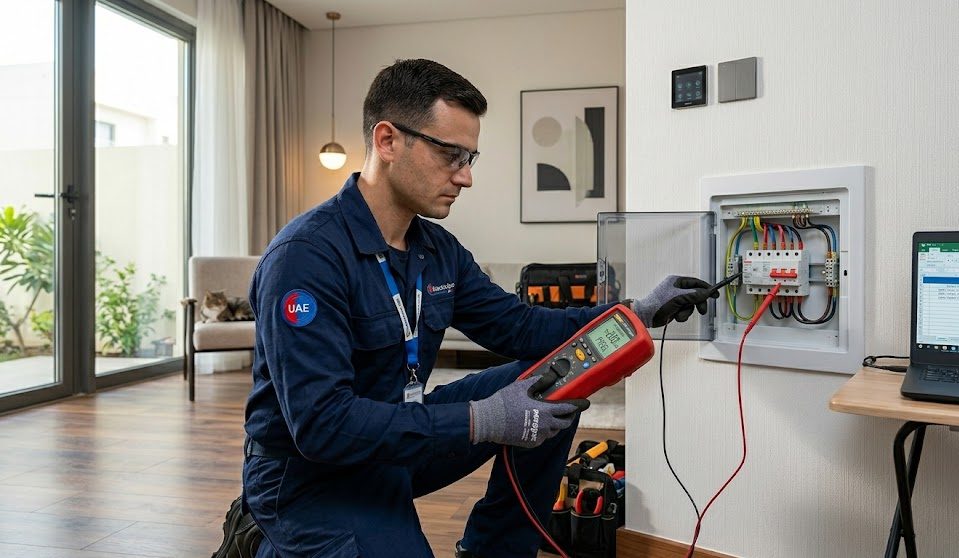
Knowing that an insulation resistance test checks the health of electrical insulation is only half the picture. The part that actually protects a building, a project handover, or an insurance claim is getting the procedure right and knowing what the resulting number means. This guide covers both, with the standards and value ranges a technician or facilities manager needs to interpret a result rather than just collect one.
If you’re looking for the basics first, our earlier post on what an insulation resistance test is and why it matters covers that ground. This one picks up where that leaves off.
What the Test Actually Measures
An electrical insulation resistance test applies a DC voltage across the insulation of a cable, motor winding, or piece of equipment and measures how much current leaks through it. Good insulation lets almost nothing through, which reads as a high resistance value in megohms. Degraded insulation, whether from heat, moisture, contamination, or age, lets more current leak, which shows up as a lower reading.
The device doing the measuring is a megohmmeter, commonly called a megger after the brand that popularised it. The test itself does not damage sound insulation, which is why it remains the standard method for both new installations and routine maintenance on equipment that stays in service for years.
Step-by-Step Insulation Resistance Test Procedure
- Isolate and discharge the circuit. Every conductor being tested must be fully disconnected from the supply and from any connected load, and any stored charge in capacitors or long cable runs needs to be safely discharged before the test leads go on.
- Select the correct test voltage. Test voltage is matched to the equipment’s rated voltage. Low-voltage equipment up to 500V is typically tested at 500V DC, while higher-voltage systems call for 1,000V, 2,500V, or 5,000V depending on the equipment class.
- Connect the leads. One lead goes to the conductor under test, the other to earth or to a second conductor, depending on whether the test is checking conductor-to-earth or conductor-to-conductor insulation.
- Apply the voltage and hold it. A spot reading is typically taken after the voltage has been applied for sixty seconds, since capacitive charging effects in the cable or winding mean the reading climbs for the first several seconds before settling.
- Record the reading and the conditions. Resistance is logged in megohms alongside the ambient temperature and humidity at the time of test, both of which affect the result significantly enough to matter for future comparison.
- Repeat across all relevant conductor pairs. A three-phase system needs readings between each phase and earth and, depending on the scope, between phases as well, not just a single overall figure.
Malco carries out professional megger and insulation resistance testing to this exact sequence as part of every electrical testing and commissioning scope.
Standards and Acceptable Insulation Resistance Values
Interpreting a reading depends on the equipment type and the standard being applied, but a few reference points cover most situations encountered on UAE electrical and MEP projects.
A commonly used minimum acceptable value for low-voltage equipment follows the formula IRmin (MΩ) = kV + 1, where kV is the rated service voltage. A result well above that minimum, often ten to a hundred times higher, is normal for insulation in good condition, and a value close to or below the minimum calls for further investigation before the equipment is energised.
For rotating machinery, IEEE 43, the recognised practice for testing insulation resistance of electric machinery, is the standard most consultants and testing bodies reference. Cable installation testing in the UAE frequently follows BS 7671 or IEC 60364-6, both of which set minimum insulation resistance values by circuit voltage and specify the test voltage to use for each.
Where longer-duration testing is required, the polarization index, the ratio of the ten-minute resistance reading to the one-minute reading, gives a clearer picture of insulation condition than a single spot reading. A polarization index below 1.0 typically signals contamination or moisture, a result between 1.0 and 2.0 is questionable, and anything above 2.0 generally indicates insulation in good condition.
Factors That Affect the Reading
Temperature has the single biggest effect on an insulation resistance reading. As a rule of thumb, resistance roughly halves for every 10°C rise above the baseline temperature and roughly doubles for every 10°C drop, which is why UAE test reports should always record ambient conditions and, where accuracy matters, correct readings to a standard reference temperature.
Humidity and surface contamination come next. Moisture and dust sitting on an insulator’s surface create a leakage path that has nothing to do with the condition of the insulation material itself, which can produce a falsely low reading if the equipment or cable termination isn’t cleaned and dried before testing.
Cable length and capacitance also matter for longer runs, since more conductor surface area means more capacitive charging current during the first seconds of the test, which is part of why the sixty-second spot reading convention exists in the first place.
When Insulation Resistance Testing Is Required
New installations need insulation testing before energisation, as part of the standard commissioning sequence alongside continuity and earth loop impedance checks, a distinction covered in more detail in our post on how a continuity test differs from an insulation resistance test.
Existing systems benefit from testing on a scheduled maintenance cycle, since insulation degrades gradually and a trend of declining readings over successive tests is often a stronger indicator than any single result. Testing is also standard practice after any modification or repair to a circuit, following fire or water damage before re-energising a system, and ahead of handover on new construction and fit-out projects, where the test forms part of the documentation package a consultant or authority will ask to see.
Insulation Resistance Testing on UAE Projects
Facilities across the UAE deal with a combination of high ambient temperature, humidity swings, and airborne dust that accelerates insulation ageing faster than in more temperate climates, which is one reason testing intervals here tend to run shorter than manufacturer defaults calibrated for milder conditions.
Malco Technical Services carries out megger and insulation resistance testing as part of electrical testing and commissioning scopes for malls, hospitals, hotels, and industrial facilities across the UAE, working from the same testing methodology covered on our electrical live and cold test service page. Results are documented against the relevant standard for the equipment class, with clear pass or fail thresholds a consultant or facilities team can act on directly.
Ready to request an insulation resistance test? Get in touch with the Malco team to schedule a site visit.
Frequently Asked Questions
What is considered a good insulation resistance reading?
There’s no single number that applies everywhere, since it depends on rated voltage and equipment type. As a general guide, readings above 100 MΩ are considered excellent, 10 to 100 MΩ is good, 1 to 10 MΩ warrants closer monitoring, and below 1 MΩ usually calls for immediate investigation before the equipment is put back into service.
How is an insulation resistance test different from a continuity test?
An insulation resistance test checks that current does not leak where it shouldn’t, by measuring high resistance between conductors or between a conductor and earth. A continuity test checks the opposite, confirming that a conductor provides an unbroken low-resistance path where current is supposed to flow.
Can insulation resistance testing damage equipment?
Properly performed testing does not damage sound insulation. The main risk comes from testing equipment that hasn’t been fully isolated and discharged first, or from applying a test voltage higher than the equipment is rated for.
How often should insulation resistance testing be repeated?
It depends on the equipment’s criticality and operating environment, but most UAE facilities schedule testing annually for standard distribution equipment, with more frequent checks for older installations, high-humidity plant rooms, or equipment with a history of declining readings.
Book a Professional Insulation Resistance Test
Getting an accurate, standards-referenced insulation resistance test result takes calibrated equipment and a technician who tests every conductor pair correctly, not just the ones that are easiest to reach. Malco Technical Services handles megger and insulation resistance testing across the UAE as part of full electrical testing and commissioning scopes.
Learn more about our megger and insulation resistance testing service.